
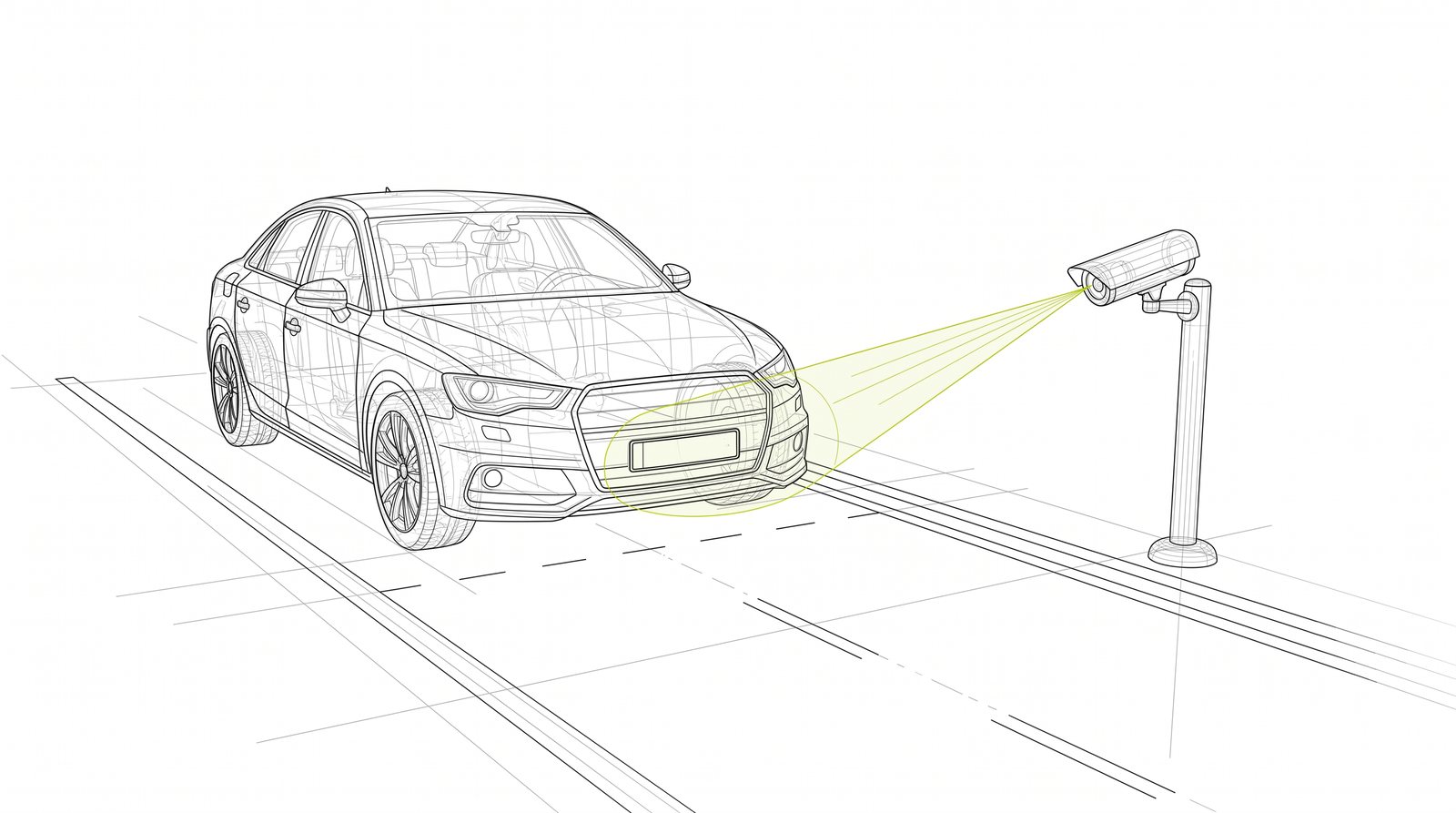
Licence plate recognition, also known as ANPR (Automatic Number Plate Recognition), LPR (License Plate Recognition) or, in German, Nummernschilderkennung, is a camera technology that reads a vehicle's licence plate and converts it into text. In car parks, multi-storey car parks and underground car parks, one camera captures the licence plate together with the time at entry, and another at exit. These two timestamps create the parking session, to which the tariff and payment are applied.
For drivers, this changes one thing above all: they don't take a ticket and have nothing to keep. For you as the operator of the site, issuing tickets, cards or transponders is no longer needed. The process works without a barrier as Free Flow Parking, and equally with a barrier, which then opens automatically for authorised licence plates.
How does a parking session with licence plate recognition work?
The vehicle enters, the camera captures the licence plate, and the parking session starts. On exit, the camera at the exit reads it again, the session is closed and the amount due is fixed.
Whether the entrance stays open or a barrier opens is decided per entrance. Both can be combined on one area, provided the zone behind the barrier has its own entrance.
- Entry: licence plate and time are recorded
- Parking time runs in the background
- Exit: the parking session is closed
- Payment via app, QR code, online afterwards or at the pay station
What is free flow parking?
Free Flow Parking means parking without a barrier and without a ticket: the entrance stays open, the camera records the licence plate on entry and exit, and no one has to stop. There's no queue at the entrance and no equipment in the way.
Where access needs to be strictly limited, for example for quotas or staff spaces, the same licence plate recognition works together with a barrier. Which solution fits when is explained in the guide on car parks with and without a barrier.
How do drivers pay when parking with licence plate recognition?
Because the parking session is tied to the licence plate, no parking ticket is needed. Drivers pay by parking app, via a QR code on the sign or online afterwards. If a pay station is available on request, drivers enter their licence plate there and pay by card, contactless or Apple/Google Pay, and with the PARQ Automat A2 also with cash.
You decide which payment options apply on your area. All payments come together in the same parking system, so you see in the portal what has been paid and what is still open. Anyone who exits without paying can pay online for 48 hours afterwards. If no payment comes in by then, or if someone stays longer than permitted, the system records the violation and transmits it via interface to the service provider for violation processing.
What affects recognition?
Viewing angle and distance matter; light does not. A camera that looks straight at the entry or exit reads more reliably than one that looks in from the side. The cameras are designed for use by day, at night and in all weather and are connected by mobile network.
What data is generated when a licence plate is captured?
The licence plate is captured with a timestamp at entry and exit, which creates the parking session. No faces, no vehicle occupants, no continuous video recording. Transmission is encrypted, and data is stored only for as long as needed for billing and evidence.
In the PARQ system