
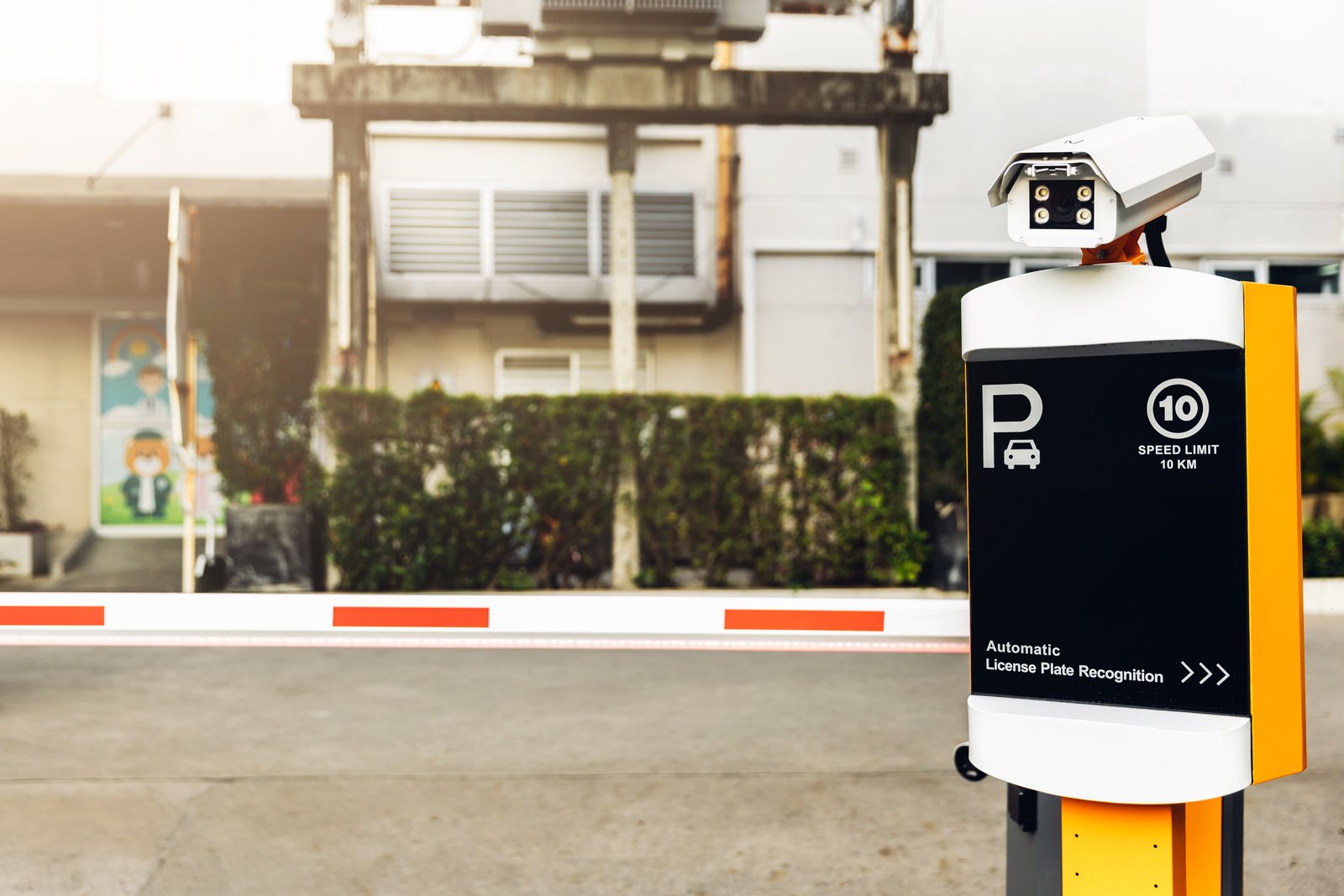
A car park or multi-storey car park without a barrier works via licence plate recognition: cameras at entry and exit capture every vehicle, the parking session runs in the background, payment is made via app, QR code, online or, on request, at the pay station. Traffic flows, and there's no tailback at the entrance. With a barrier, by contrast, only those allowed in get in, and the barrier opens automatically for authorised licence plates, without a ticket.
Both approaches aren't mutually exclusive. Combining them on one site is called hybrid parking: parts of the site remain freely accessible, others sit behind the barrier with their own access. Which solution fits where depends on your parkers, the layout of the site, and how strictly access needs to be controlled.
How does a multi-storey car park without a barrier work?
Every entry and exit gets a camera with licence plate recognition. The parking session starts on entry and ends on exit, and the tariff is applied to it. Anyone who does not pay can pay online within 48 hours; after that, or if the permitted parking time has been exceeded, the violation is sent via interface to the service provider for violation processing.
The rules are displayed on signs at the entrance so everyone knows what applies: tariff, free period, maximum parking duration and payment methods.
Car parks and multi-storey car parks without a barrier: when that fits
If you have many short-term parkers, need to absorb peaks, and the tailback at the entrance is the bigger problem, this favours an open entrance. Barrier-free parking removes the waiting time at entry, because no one has to stop, take a ticket or hold up a card.
Even with several entrances, the barrier-free solution is often the simpler one: every entry and exit gets a camera, and the construction effort is lower than with a barrier.
When does a barrier system make sense?
Zones with quotas, staff spaces and sites that no one should drive onto without authorisation are better served with a barrier or roller door. The electric barrier only opens for licence plates permitted to enter, such as staff, tenants or parkers with a booked ticket.
Existing barriers and roller doors can continue to be used and controlled via licence plate recognition, provided their control system allows it. A new barrier is only added where none exists.
Hybrid parking: both on one site
Visitors park freely, while the zone for staff sits behind the barrier: this is how a site can be divided without operating two systems. In the portal, it remains a single site with different zones and rules.
With quotas, the barrier becomes a control mechanism: as long as spaces remain within the quota, it opens; once the quota is full, the entrance stays closed. This lets you keep track of how many vehicles from a group are on the site at the same time.
In the PARQ system