
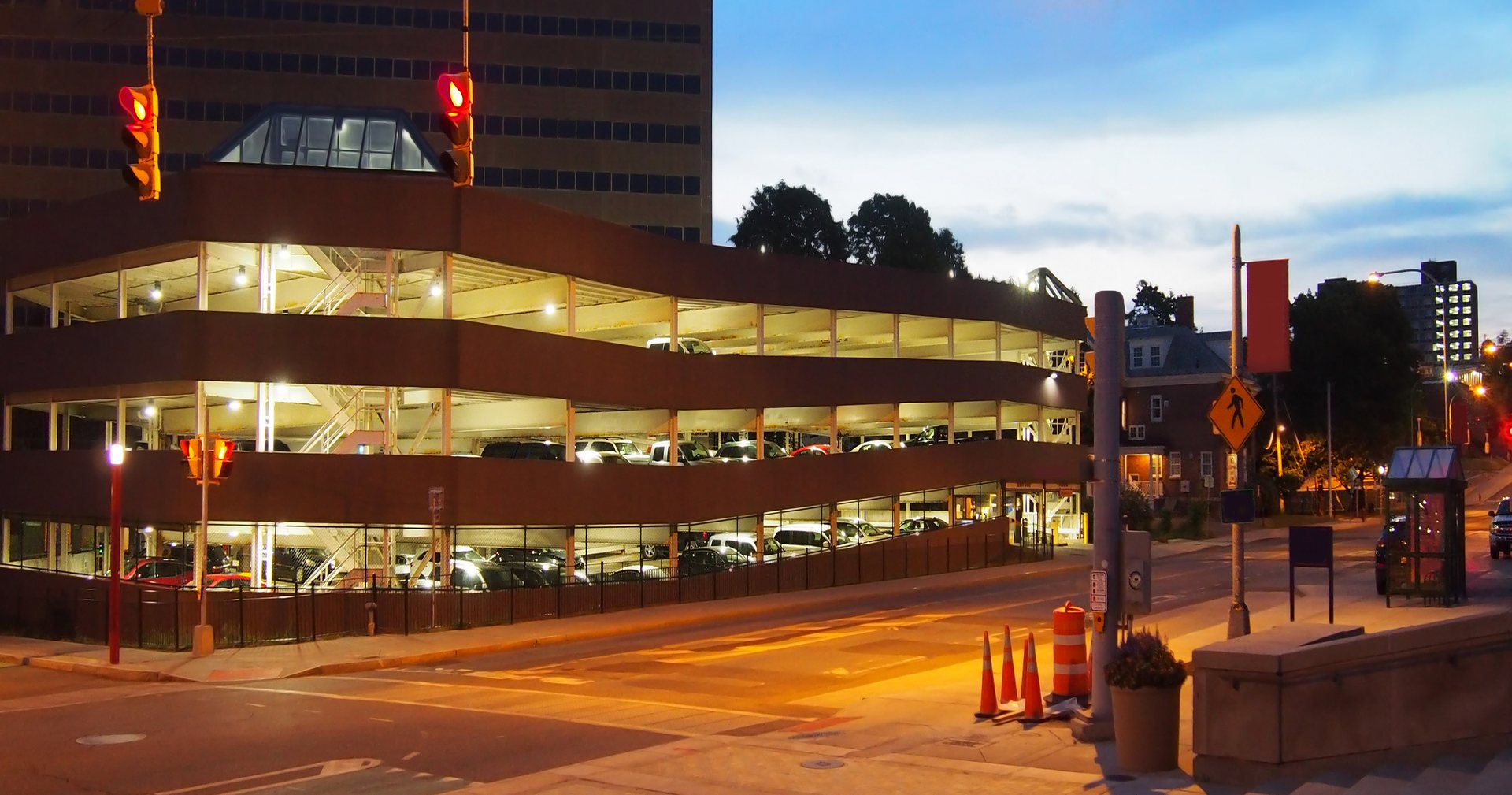
Running a multi-storey or underground car park yourself means: you manage tariffs, permit holders and revenue in your own portal instead of handing over operations. With licence plate recognition from PARQ, this needs neither a parking ticket nor a pay station at the exit.
This suits a city or municipal utility car park just as well as the underground car park beneath a hotel, a clinic, a shopping centre or a residential complex.
- Entrance
- Free entry without stopping or with a barrier; existing barriers and roller gates can be connected
- Pay
- By licence plate via app, QR code or online, at the pay station on request
- Long-stay parkers
- Authorised via licence plate, without a card or remote control
- Tariffs and tickets
- You decide, such as night, weekend or monthly tickets
- Start
- Usually around 30 days after the order
What changes in the multi-storey car park
Cameras capture the licence plate on entry and exit. The licence plate replaces the ticket: drivers do not take a ticket and do not queue at exit. Payment is made based on the licence plate.
This removes the need for ticket printers and ticket rolls, and you can see at any time who is currently parked in the building.
Free entry or with a barrier?
As a rule, the entrance stays open, and drivers enter and exit without stopping; this is called Free Flow Parking. A barrier is worthwhile where access is to be strictly limited, such as for a fixed quota or a deck for employees only.
An existing barrier or roller gate can be connected via its controller and then opens by licence plate recognition. Only what is missing is added, usually the cameras at the entrances and exits. This keeps the conversion small, and the multi-storey car park remains usable during the changeover.
How drivers pay
Drivers pay via app, via QR code or online afterwards. A pay station can be added on request, with or without cash.
You set the tariffs yourself, along with bookable tickets. An example: a night ticket for residents, a weekend ticket for day-trippers and a monthly ticket for commuters. Which tickets exist and what they cost is for you to decide in the portal.
How permit holders, tenants and employees park
Regular parkers are authorised via their licence plate, permanently or for a limited period, and park free of charge, for example. No cards or remote controls are needed, and a new licence plate is registered in the portal in a few clicks.
If an area has its own entrance with a camera, such as a deck for employees, its own rules apply there.
What you see in day-to-day operation
In the portal you see live how full the multi-storey car park is, which parking sessions are running and which payments have come in. Anyone who does not pay has 48 hours to pay online afterwards; after that, the system automatically transmits the violation to a service provider for violation processing.
Occupancy over the course of the day, parking duration and revenue can be analysed and exported, and there is much more data than this.
How the changeover works
In the configurator you enter your multi-storey car park step by step, with entrances and exits, barriers and pay stations, and see a price range as an estimate. After that, we get in touch for an initial discussion and plan together what stays and what is added.
The technology arrives preconfigured, is installed and is usually up and running around 30 days after the order. You can buy, lease or rent the hardware; the software is added as a monthly usage fee.