
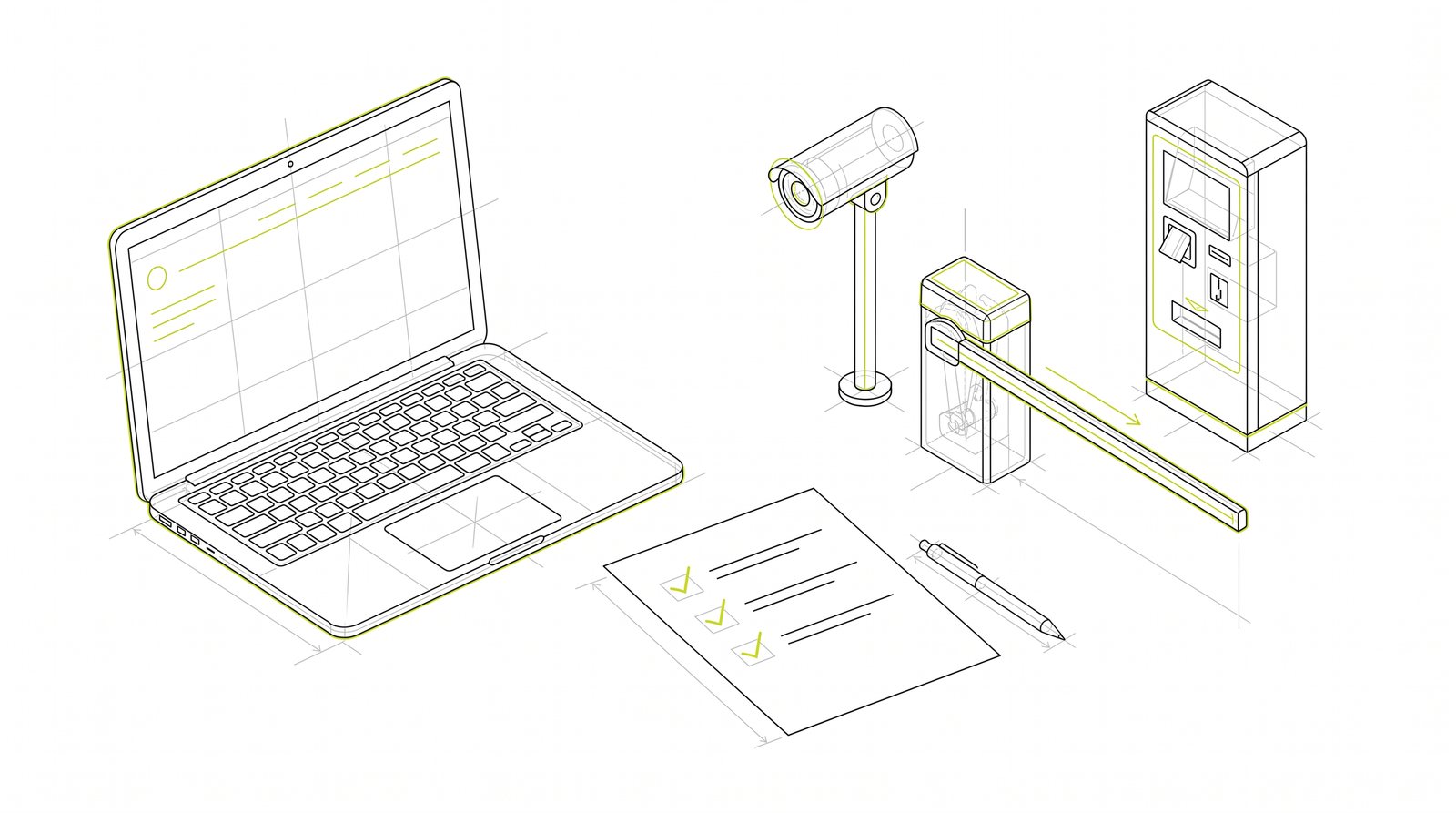
A parking system is the technology used to run a parking site: cameras with licence plate recognition at the entrance, with a barrier, app, QR code, online payment or pay station if you wish. There is also a portal where tariffs, authorisations, payments and reports come together. Anyone running their own parking site therefore buys not a single device but an ecosystem whose components have to fit together.
Before comparing providers and offers, it is worth clarifying a few questions: What does the site look like? Should it be monitored or managed as paid parking? Who parks there, how should payment work, and who handles day-to-day operation? The answers determine which technology is even an option and which offers can sensibly be compared side by side.
What does the area look like?
The number and location of entrances determine how many cameras are needed and whether a barrier makes sense. A parking area with a single entrance can be solved differently from a multi-storey car park with several levels or an underground car park with separate entry and exit.
Also check what is structurally already in place: power at the entrance, an existing roller shutter, a barrier or a pay station from the old system. Existing barriers and roller shutters can be connected, provided their controls allow it; existing pay stations depending on the manufacturer.
- How many entrances and exits are there?
- Is there power at the entrance?
- Is there an existing barrier, roller shutter door or pay station?
- How many parking spaces does the area have?
Free parking or paid parking?
If parking stays free, what matters is who is on the site and for how long; in the industry this is called enforcement. Cameras with licence plate recognition and the portal are enough for this, and a pay station is not needed. This suits sites where parking is free but only for certain groups or only for a limited time.
If parking costs something, it is called parking management. Tariffs and payment options are then added: app, QR code, online payment afterwards and, if you wish, a pay station. A barrier is needed only where access is to be strictly limited, for example for quotas or staff spaces. The two can be combined on one site and extended later, when an enforced site becomes a managed one.
Who parks with you?
Guests, staff, residents, suppliers and short-term visitors all have different rights. A parking system must be able to separate these groups without anyone sitting at the entrance to decide.
The more clearly you describe the groups beforehand, the easier it is to map the rule in the portal later: as a tariff, as a authorisation for specific licence plates, or as a ticket booked in advance.
- Which groups are to park free of charge?
- Who pays by time, who pays a flat rate?
- Are there zones with their own entrance?
- Should it be possible to book in advance?
How is payment to be made?
By parking app, via a QR code on the sign, online afterwards and, on request, at the pay station by card, contactless or Apple/Google Pay, and with the PARQ Automat A2 also with cash: the more ways are open, the fewer queries reach you.
What matters is that all options come together in the same parking system and that you have a single view of turnover and outstanding claims. Clarify early on which payment methods your organisation already uses; existing integrations with payment service providers save coordination effort.
Who runs the area day to day?
However good a system may be, someone has to maintain tariffs, grant authorisations and answer queries. Check how many steps a typical week costs and how quickly new rules take effect.
Anyone taking on operations themselves needs a portal where everything is in one place: parking sessions, payments, violations, tariffs and reports and analytics.
Smart parking comparison: which questions help?
A smart parking comparison becomes meaningful when you ask every provider the same questions. What matters is less the individual camera than how everything works together: whether recording, rules, payment and reporting sit in one system or are spread across several providers.
- Can existing technology be connected?
- Can you change tariffs and authorisations yourself?
- Do all payment methods come together in one parking session?
- How are violations recorded and transmitted?
- What reports, analytics and exports are available?
- Can the system be extended later?
In the PARQ system